nuffnang

Wednesday, June 22, 2011

1 Sentence 8 Different Meanings

READER Tam Yong Yuee of Mind Our English - The Star, sent in this snippet about Professor Ernest Brennecke of Columbia who is credited with inventing a sentence that can be made to have eight different meanings by placing one word in all possible positions in the sentence, “I hit him in the eye yesterday.” The word is “only”.

1. ONLY I hit him in the eye yesterday. (No one else did.)

2. I ONLY hit him in the eye yesterday. (Did not slap him.)

3. I hit ONLY him in the eye yesterday. (I did not hit others.)

4. I hit him ONLY in the eye yesterday. (I did not hit outside the eye.)

5. I hit him in ONLY the eye yesterday. (Not other organs.)

6. I hit him in the ONLY eye yesterday. (He doesn’t have another eye.)

7. I hit him in the eye ONLY yesterday. (Not today.)

8. I hit him in the eye yesterday ONLY. (Did not wait for today.)


source:http://thestar.com.my/english/story.asp?file=/2011/5/26/lifefocus/8695332&sec=lifefocus

Tuesday, June 21, 2011

Has or Had?

Has or had

THIS was a question in my child’s school test paper:

I saw a proboscis monkey which ______ a huge nose in the zoo last week.

A. has B. had C. have D. having

The answer given was A. Has

Please tell me why the answer is not B. Had to synchronise with the past tense of the sentence viz “saw” and “last week”. – A mother

The answer can be either B or A. The sentence uses a past reporting verb “saw”. A verb of perception can be used to report what you or other people see, hear, etc. (See Collins Cobuild English Grammar 2nd edition, 2005, p.316, 7.10 “verbs of learning and perceiving” and p.321, 7.27 “verbs used with ‘that’-clauses”). When a past reporting verb is used in a sentence, the relative clause that follows it also uses a past tense (tense consistency). Hence “had” is used:

“I saw a proboscis monkey which had a huge nose in the zoo last week.”

However, when reporting something that is permanent, a present tense verb can be used. Since proboscis monkeys always have huge noses, we can also use “has” in the sentence:

“I saw a proboscis monkey which has a huge nose in the zoo last week.”

Below are some examples of the use of the present tense and the past tense in similar sentences on the Internet:

“Back into the main area, we saw a Gymnocereus [a type of cactus] which has an odd habit, growing as a sprawling, spreading plant.”

(from British Cactus & Succulent Society, Southampton & District Branch Newsletter, December 2009)

The odd habit described is a permanent feature of the plant: so the present tense verb “has” is used.

“We saw a puffin which had about eight sand eels in its mouth to feed its young.” (from a report on a school trip to Skomer Island, off the coast of south-west Wales, UK)

Puffins don’t always have “eight sand eels in its mouth to feed its young”: so the past tense verb “had” is used in the relative clause.


By FADZILAH AMIN - thestar.com.my

Monday, June 20, 2011

Madam, Teacher or Cikgu?

By FADZILAH AMIN - thestar.com.my


IT is acceptable to call a doctor whose name is Siti, Dr Siti and a police inspector whose surname is Lee, Inspector Lee? Is it all right to call a teacher whose name is Siti, Teacher Siti? Do we call a married teacher whose name is Lucy Lau Madam Lau? Is it correct to call this teacher Madam Lucy? Or is it more accurate to call her Madam Lucy Lau? – Bryan Yap Jet Rong

It is acceptable, in fact usual, to call (or more formally “address”) a police inspector whose surname is Lee, “Inspector Lee”. But a lady whose first name is “Siti” usually has another name after that, like “Siti Fatimah”. So, you should address her as “Dr Siti Fatimah” unless she has told you to address her as “Dr Siti” only.

You don’t address a teacher as “Teacher + her/his name”, but you may say “Cikgu + her/his name”. When addressing a Malaysian teacher, you may also use one of the following words before her or his name, whichever is appropriate: Puan, Encik, Cik, Mrs, Mr, Miss or Ms (pronounced Miz). When you have a new teacher, it is a good idea to ask the teacher what she or he would like to be called. (Ms, by the way, is a fairly new term that doesn’t indicate a lady’s marital status.)

As for the term “Madam” for married Chinese women teachers, a Chinese friend of mine (who was a teacher) explained the following to me. You use “Madam” with the lady’s father’s surname, but “Mrs” with the lady’s husband’s surname. Thus if Lucy Lau is married to Mr Lau, you call her “Mrs Lau”. If her original surname is Lau and she is married to a Mr Lim, for example, you can call her either “Madam Lau” or “Mrs Lim”. But as I said before, ask her what she would like to be called.

I don’t think you should call her “Madam Lucy” or “Madam Lucy Lau” unless she tells you to.

Wednesday, April 13, 2011

The Curse: Elements of a novel

The elements of a novel include the following:


i. Plot - the structure of a novel. It shows the arrangement of events and actions within
a story (please refer to notes on Freytag‟s Pyramid below for details).

ii. Setting - the time, place, physical details, and circumstances in which a situation
occurs. Setting enables the reader to better envision how a story unfolds by relating
necessary physical details of a piece of literature.

iii. Theme - is the main idea, or message, of an essay, paragraph, or a book. The
message may be about life, society, or human nature. Themes often explore
timeless and universal ideas and may be implied rather than stated explicitly. Along
with plot, character, setting, and style, theme is considered one of the fundamental
components of fiction. It is the universal statement or feel when you read a piece of
writing.

iv. Character and characterisation - a character is a person in a narrative who may
represent a particular class of group of people. Characters in a novel a the vehicle
by which author conveys to us his / her view of the world. Characters maybe classify
either main character or minor character. The characterisation of a character is
revealed by actions, speech, thoughts, physical appearance, and the other
characters‟ thoughts or words.

v. Language - used by author to reveal the theme and purpose of the novel.

Friday, March 25, 2011

Novel: The Curse

What is a novel?


Only in a novel are all things given full play – D. H. Lawrence


A novel is a long narrative in literary prose. Novels tell stories, which are typically
defined as a series of events described in a sequence. The novel has been a part of human
culture for over a thousand years, although its origins are somewhat debated. Regardless of
how it began, the novel has risen to prominence and remained one of the most popular and
treasured examples of human culture and writing.

There have been stories and tales for thousands of years, but novels must combine a
few unique characteristics in order to be defined as such. First, a novel is written down,
rather than told through an oral account. Secondly, novels are meant to be fictional in form,
differentiating them from myths, which are said to have their basis in reality or theology.
Although some modern scholars argue differently, there is no truly established guideline for
length, point-of-view, or even establishment of a moral or philosophical point in novels.

Tuesday, March 22, 2011

Complaining Frequency

I am back people! (errkk.. is anybody still visiting this blog?)

Anyway,

I have this interesting thought to share;

A Secret Scrolls message from Rhonda Byrne
Creator of The Secret and The Power

From The Secret Daily Teachings

If you are complaining about things in your life, you are on the complaining frequency, and you are not in a position to attract what you want.

Get on to the frequency of good with your thoughts and words. Firstly you will feel good, and secondly you will be on the frequency of receiving more good.
May the joy be with you,

Tuesday, March 15, 2011

English Literature Component Courseware: My First Experience

This semester, I had a chance to learn something new!

Instructional Computer Technology. I maybe quite a late bloomer on this.. haha, but people say, better late then never, right.

Anyway, for this class my friend and I decided to do a courseware on THE CURSE!


Tuesday, February 08, 2011

Armchair Critic

The English Language is rich in vocabulary, including its ways of expressing distinctions meaning.

It is particularly rich in in idiomatic expressions.

Here is an example;

An armchair critic means a person who critically judges others' work and gives advice, but who has not himself experienced doing the work.

Wednesday, January 26, 2011

Monday, January 10, 2011

http://englishrescueteam.com

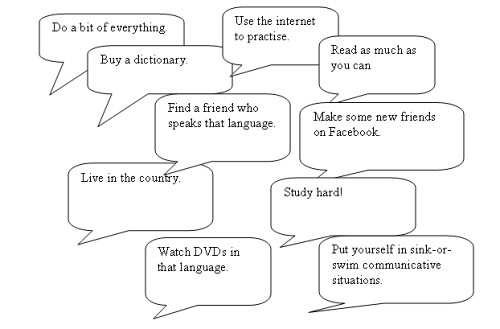
What’s The Best Way To Learn A New Language?

Written by David

source: http://englishrescueteam.com/whats-the-best-way-to-learn-a-new-language/


It’s a million dollar question. Everyone has a different way of learning and different ideas of how best to learn. We’ve asked several of our colleagues and students here at the British Council what they think. Here’s what they said:

bubbles3

Saturday, January 01, 2011

2011

"If the students don't learn d way we teach, then, teach them the way they learn."

Happy New Year...

Monday, December 13, 2010

the difference between towards, toward and to.

To, toward, towards

Your Questions Answered by : FADZILAH AMIN

thestar.com.my

I CANNOT tell the difference between towards, toward and to.

Examples:

a) Thank you for your effort/contribution (towards, toward or to) the implementation of the project.

b) Thank you for your effort/contribution (towards, toward or to) the completion of the project.

c) Thank you for your effort/contribution (towards, toward or to) the launch of the project.

d) Thank you for your effort/contribution (towards, toward or to) the start/end of the project. – Paul Chan

If you want to write British English, use “towards” or “to”. “Toward” is used in American English, which also uses “towards”.

“Effort” and “contribution” can be used with “towards” in all your sentences.

“Contribution” can also be used with “to” in all your sentences.

However, “effort” cannot be followed by “to” in any of your sentences, where “to” is used as a preposition. If you use “effort” in a sentence beginning, like yours, with “Thank you for your effort to ...”, the “to” there is an infinitive marker and must be followed by an infinitive. I shall alter the ends of your sentences so that they contain infinitives, in order to use “effort” with them:

Thank you for your effort to implement the project.

Thank you for your effort to complete the project

Thank you for your effort to launch the project.

Thank you for your effort to start/end the project.

I find that the altered sentences have meanings that are slightly different from the originals, where “effort” or “contribution” is used with “towards”, or where “contribution” is used with “to”. The altered sentences suggest that the person addressed (“you”) has worked single-handedly to implement/complete/launch/start/end the project. The original sentences suggest a group effort, where “you” only contributed “your” share. So it’s best not to use “effort” with either kind of “to” in your sentences.

Wednesday, November 24, 2010

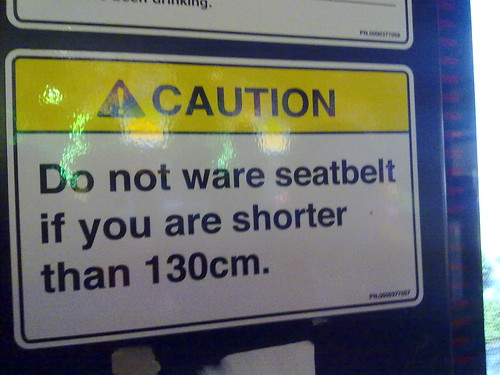
What's Wrong With The Menu?

Whoaaahh.. It has been quite awhile since my last entry! It took me a minute or two to recall the password for this blog! phewww... 

Anyway, let's see the photo I took during my last visit to a kopitiam nearby my place. 


211120107488


so, can you please tell me what's wrong with the menu?

Friday, November 05, 2010

Are You Agree?

English Fast & Easy Here is your English tip for today.

Don't say: "Are you agree?" Say: "Do you agree?" Don't say: "I'm not agree." Say: "I don't agree." Now, here is my question to you. Exams are fun. Do you agree?

You can just say: "We agree." or "I agree." Don't say: "I'm agree

taken from:
http://www.facebook.com/pages/English-Fast-Easy/143350989041499

Wednesday, October 20, 2010

English Fast & Easy Facebook page.

Miss Pascal paid me a visit again, and this time she has this to inform all of you...


Hello again Miss Sensei

Hope you are well this October.

Just wanted to let you know that I have just created the English Fast & Easy facebook page.

Through the page, I will be sending out English tips once a week. The tips deal with common Malaysian English challenges.

You can become a fan by going to
http://www.facebook.com/pages/English-Fast-Easy/143350989041499

If you think your followers might enjoy receiving a weekly tip through facebook, would you mind posting ( NOT would you mind to post:)) the link for them.

English Fast & Easy 2 will be out in December! It is similar to the original but teaches useful vocabulary instead of phrases.

Finally, I would like to offer your school my 45-minute talk on English For a Global Environment free of charge! If interested, please contact me asap.

Best regards
Marianna

Wednesday, October 13, 2010

Never Ever

Never ignore someone ,who really cares for you....
because some day you may realize that you have lost a DIAMOND while you were busy in collecting stones

Wednesday, October 06, 2010

How To Do Your Assignments

College assignments may be different than the ones you completed in secondary school. Here are several tips that may help you succeed in your assignments.

  1. Read the assignment thoroughly. Make sure that you understand what the lecturer is looking for as a deliverable.
  2. Use standard English grammar and spelling. Though abbreviations and lack of capitalization or punctuation may be fine in text messages or Twitter, they are definitely not acceptable in other written assignments. Need help with grammar? Check out Grammar Girl’s Quick and Dirty Tips for Better Writing.
  3. Use spell check. Don’t rely on it exclusively, but do use it.
  4. If there’s a minimum or maximum word or page count, write enough, but not too much.
  5. Consider writing a draft of your assignment for your instructor to review prior to the deadline. (Yikes — check the second definition included in the deadline link.)
  6. Post or turn in your assignment by the deadline. Many instructors (including me) do not accept late work. (See some views on late work at the Chronicle of Higher Education’s website.)
  7. Thoroughly review your course syllabus. Many instructors include a weekly schedule of discussions and assignments. Don’t be surprised if when you ask when an assignment is due, your instructor replies, “You’ll find that in the syllabus.” Check WebCT Vista for due dates if they are not specified on the syllabus.
  8. When taking a quiz or test in WebCT Vista, make sure you are aware what the rules are for using materials to help you take the test, that you know how many tries you have, and how the final score is calculated. (In many of my classes, the quizzes are “open-everything,” at least two tries are allowed, and highest score counts. But that’s just me.)
  9. If your instructor specifies or indicates a preference for fonts and margins, use these when writing your assignment.

Tuesday, October 05, 2010

Reading – A Great Way To Learn English

Finally an update! yeayy! 

I really believe in this... 

Learning the English language can be a difficult task. There many methods of learning English to help you overcome the various problems associated with grammar, spelling, pronunciation, and even English slang. One method is actively reading. The more that you read, the more you broaden your understanding of the language, and as a result, the faster you will learn to read and speak English.

Textbooks are a very helpful learning tool, but newspapers, magazines, and novels are great ways to give you a better understanding of the English language. You will learn the various English expressions, phrases, sentence structures, and words, which will help improve your vocabulary. Make sure that you keep a dictionary close by when you start reading because some words and phrases can be tricky.

Reading on your own is not just effective, but it is also extremely motivating. When you read on your own, you will be reading something that you have chosen. It will be interesting because it is what you chose, rather than something your teacher told you to read. As a result, you read much more willingly. Learning words naturally is both fun and educational. You will also learn how to use the correct words at the appropriate time. Generally, you should read at least a few pages per day. If you believe that you do not have time to read, take a book or magazine with you everywhere that you go. This will allow you to read in a variety of places such as when you are waiting in a long line at a bank or traveling on a bus.

Students who read a lot will actually learn to think in English. When students read every day, they will first learn slowly, but then they eventually start to learn faster and more easily. Reading helps the brain concentrate on English. Your brain will be repeating the words and phrases that it has seen many times. By reading a book in English, you have given your brain thousands of English sentences. Soon, you will begin speaking the language with confidence.

Reading is a great way to review and remember English words. By reading newspapers and magazines, students will remember what they learned long after they have completed an English learning class. As well, reading is an activity that can be enjoyed by all ages.

Reading maps is also a helpful tool. It will expand your knowledge of the geographic areas. If you are in business, you will most likely be required to write in English. Reading will help your writing because it will provide you with more expressions that you were not previously familiar with.

When reading English, phrases will eventually come easy to you when you are writing or speaking the language. Things like verb tense and how to use words such as “however” will become part of your understanding of the language. You will start to use them correctly without thinking. Correct phrases will just appear in your head. Also, when you read something that matters to you, you will remember it more. For example, if you read the lyrics of a new song by your favorite band, you are much more likely to repeat them and keep the words and phrases in your memory.

Reading and listening are both great ways to learn English, but reading is usually much easier than listening. With the aid of a good dictionary, you can understand English texts much more easily. The more you read, the easier it will become. It is not always easy, but it is worth the effort.

Saturday, September 04, 2010

10 Amazing Lessons From Einstein

Albert Einstein has long been considered a genius by the masses. He was a theoretical physicist, philosopher, author, and is perhaps the most influential scientists to ever live.

Einstein has made great contributions to the scientific world, including the theory of relativity, the founding of relativistic cosmology, the prediction of the deflection of light by gravity, the quantum theory of atomic motion in solids, the zero-point energy concept, and the quantum theory of a monatomic gas which predicted Bose–Einstein condensation, to name a few of his scientific contributions.

Einstein received the 1921 Nobel Prize in Physics “for his services to Theoretical Physics, and especially for his discovery of the law of the photoelectric effect.”

He’s published more than 300 scientific works and over 150 non-scientific works. Einstein is considered the father of modern physics and is probably the most successful scientist there ever was.


10 Amazing Lessons from Albert Einstein:

  1. Follow Your Curiosity

    “I have no special talent. I am only passionately curious.”

    What piques your curiosity? I am curious as to what causes one person to succeed while another person fails; this is why I’ve spent years studying success. What are you most curious about? The pursuit of your curiosity is the secret to your success.

  2. Perseverance is Priceless

    “It's not that I'm so smart; it's just that I stay with problems longer.”

    Through perseverance the turtle reached the ark. Are you willing to persevere until you get to your intended destination? They say the entire value of the postage stamp consist in its ability to stick to something until it gets there. Be like the postage stamp; finish the race that you’ve started!

  3. Focus on the Present

    “Any man who can drive safely while kissing a pretty girl is simply not giving the kiss the attention it deserves.”

    My father always says you cannot ride two horses at the same time. I like to say, you can do anything, but not everything. Learn to be present where you are; give your all to whatever you’re currently doing.

    Focused energy is power, and it’s the difference between success and failure.

  4. The Imagination is Powerful

    “Imagination is everything. It is the preview of life's coming attractions. Imagination is more important than knowledge.”

    Are you using your imagination daily? Einstein said the imagination is more important than knowledge! Your imagination pre-plays your future. Einstein went on to say, “The true sign of intelligence is not knowledge, but imagination.” Are you exercising your “imagination muscles” daily, don’t let something as powerful as your imagination lie dormant.

  5. Make Mistakes

    “A person who never made a mistake never tried anything new.”

    Never be afraid of making a mistake. A mistake is not a failure. Mistakes can make you better, smarter and faster, if you utilize them properly. Discover the power of making mistakes. I’ve said this before, and I’ll say it again, if you want to succeed, triple the amount of mistakes that you make.

  6. Live in the Moment

    “I never think of the future - it comes soon enough.”

    The only way to properly address your future is to be as present as possible “in the present.”

    You cannot “presently” change yesterday or tomorrow, so it’s of supreme importance that you dedicate all of your efforts to “right now.” It’s the only time that matters, it’s the only time there is.

  7. Create Value

    “Strive not to be a success, but rather to be of value."

    Don’t waste your time trying to be successful, spend your time creating value. If you’re valuable, then you will attract success.

    Discover the talents and gifts that you possess, learn how to offer those talents and gifts in a way that most benefits others.

    Labor to be valuable and success will chase you down.

  8. Don’t Expect Different Results

    “Insanity: doing the same thing over and over again and expecting different results.”

    You can’t keep doing the same thing everyday and expect different results. In other words, you can’t keep doing the same workout routine and expect to look differently. In order for your life to change, you must change, to the degree that you change your actions and your thinking is to the degree that your life will change.

  9. Knowledge Comes From Experience

    “Information is not knowledge. The only source of knowledge is experience.”

    Knowledge comes from experience. You can discuss a task, but discussion will only give you a philosophical understanding of it; you must experience the task first hand to “know it.” What’s the lesson? Get experience! Don’t spend your time hiding behind speculative information, go out there and do it, and you will have gained priceless knowledge.

  10. Learn the Rules and Then Play Better

    “You have to learn the rules of the game. And then you have to play better than anyone else.”

    To put it all in simple terms, there are two things that you must do. The first thing you must do is to learn the rules of the game that you’re playing. It doesn’t sound exciting, but it’s vital. Secondly, you must commit to play the game better than anyone else. If you can do these two things, success will be yours!

Thank you for reading and be sure to pass this article along!


Written on 3/09/2010 by Mr. Self Development who is a motivational author that offers a practical guide to success and wealth; support him by visiting his blog at mrselfdevelopment.com. .

Friday, September 03, 2010

A Visit To Turtle Santuary

1 (210)

Few weeks ago, my students and I went to Cherating Turtle Sanctuary. It was indeed a very informative and enjoyable trip.

Blog Widget by LinkWithin